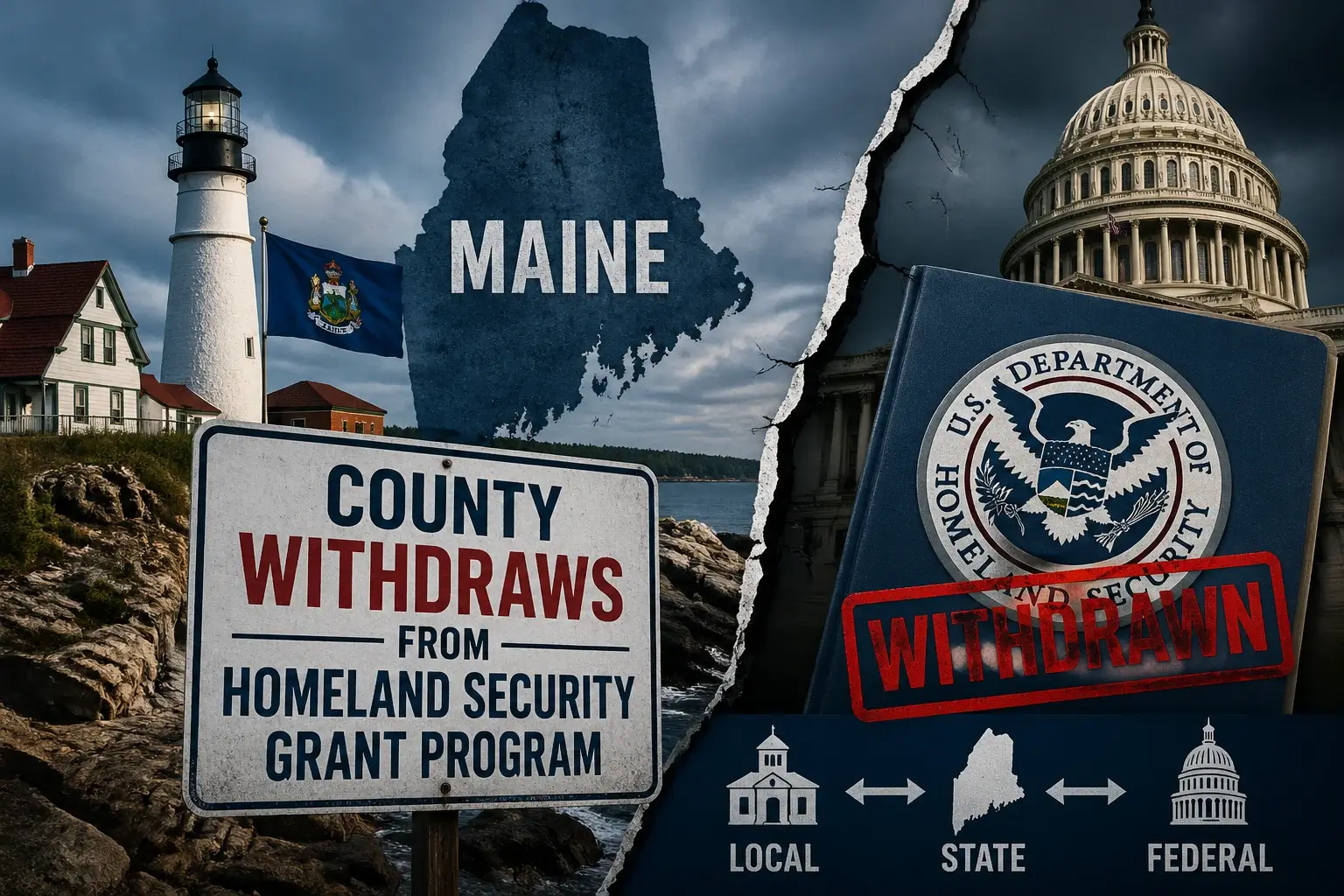
Maine County Withdraws from Homeland Security Grant Program: A Deep Dive into Local, State, and Federal Tensions

In a significant move that has stirred both local and national discourse, Lincoln County, Maine has made the decision to withdraw from the Homeland Security Grant Program (HSGP). This decision comes amidst growing tensions between local law enforcement policies and federal requirements, particularly regarding immigration detainers and cooperation with U.S. Immigration and Customs Enforcement (ICE). The decision could have substantial consequences for the county’s emergency preparedness and disaster response funding.
What Triggered the Decision?
The county’s decision stems from ICE cooperation requirements attached to the Homeland Security grants. Under the HSGP conditions, local jurisdictions receiving federal emergency preparedness funding must adhere to certain immigration enforcement standards. These standards often require local law enforcement to cooperate with federal agencies like ICE in detaining individuals under immigration detainers—a condition that has sparked significant controversy.
Carrie Kipfer, head of Lincoln County Emergency Management, voiced the county’s concerns: “We are not in the business of immigration enforcement. Our job is to ensure public safety and emergency preparedness, not to act as an extension of federal immigration policy.”
Federal Grant Conditions Explained
The U.S. Department of Homeland Security (DHS), along with the Federal Emergency Management Agency (FEMA), mandates that local governments receiving federal funding under HSGP must comply with certain terms, including immigration enforcement cooperation. Specifically, these grants are meant to support emergency preparedness and disaster resilience efforts, but under the current guidelines, the condition to honor immigration detainers and administrative warrants has led to a significant conflict between local autonomy and federal control.
This policy conflict is rooted in the question of whether local law enforcement should assist ICE in detaining individuals, especially when those individuals have not been charged with criminal offenses. The HSGP funding conditions are seen by many as a federal overreach, compelling local agencies to take on duties that many local officials believe are not their responsibility.
Local Government Opposition
Sheriff Todd Brackett of Lincoln County has been a vocal opponent of cooperating with ICE detainers, emphasizing the distinction between civil immigration detainers and criminal warrants. The sheriff’s office has a strict policy of not holding individuals unless they are facing criminal charges, making compliance with federal immigration enforcement a clear violation of local law.
The Two Bridges Regional Jail in Wiscasset, Maine, has also adopted a policy of not holding non-criminal detainees. This jail policy, combined with the county’s refusal to cooperate with ICE, has led to significant political and legal challenges for both the local sheriff’s office and the Maine Emergency Management Agency (MEMA).
Funding Breakdown & Intended Use
The Homeland Security Grant Program was expected to provide between $90,000 and $135,000 to Lincoln County for a range of emergency preparedness projects. These funds were intended for critical infrastructure, including:
- Communication towers
- Backup generators
- Emergency response equipment
- Narcotics testing tools
These funds are essential for enhancing the county’s disaster resilience and emergency response capabilities, but with the withdrawal from the program, Lincoln County will now have to find alternative means of financing these essential projects.
Legal & Policy Conflict Analysis
At the heart of this dispute is the tension between federal and local authority. ICE detainers are typically considered civil matters, not criminal, meaning that local law enforcement is not legally required to comply with them. However, the federal grant conditions have framed compliance with these detainers as a requirement for continued funding under the Homeland Security Grant Program.
This creates a legal conundrum for local jurisdictions, particularly those like Lincoln County that prioritize local law enforcement policies and the protection of civil rights. Emily Huber, an attorney with the American Civil Liberties Union (ACLU) of Maine, explained, “When local law enforcement acts on immigration detainers, it crosses the line between civil and criminal law enforcement, violating constitutional protections.”
Official Statements
To further clarify the reasoning behind the decision, Lincoln County Emergency Management Director, James Bailey, provided an official statement: “This decision was not made lightly. The Homeland Security Grant Program funding is vital for our community, but we cannot sacrifice our core values of public safety and civil rights by participating in immigration enforcement.”
Similarly, Maine Attorney General Aaron Frey weighed in: “While we fully support the county’s emergency preparedness efforts, we also understand the critical balance between federal funding requirements and maintaining local autonomy.”
Impact on County & Residents
The decision to withdraw from the HSGP has immediate and long-term consequences for Lincoln County and its residents. The loss of up to $135,000 in funding will likely result in:
- Increased local tax burden to fund emergency preparedness projects
- Reduced funding for essential services like communication towers and backup generators, potentially leaving the county vulnerable during natural disasters
- Long-term risks related to disaster response capabilities and emergency management efficiency
While the Sheriff’s Office and county officials argue that these steps are necessary to maintain local control, the community’s ability to respond to emergencies will likely be impacted.
National Political Context
The national debate on federal immigration policies and their impact on local jurisdictions continues to grow. The Trump Administration’s hardline stance on immigration enforcement has set the stage for many of the current tensions. However, the Biden Administration has shifted the focus to immigration reform, leaving some local officials to reconsider their stances on ICE detainers.
Furthermore, this issue is not unique to Maine. Several other states and municipalities have been involved in legal disputes with federal agencies over Homeland Security Grant Program conditions, creating a patchwork of policies that vary by jurisdiction.
Future Outlook
Looking ahead, Lincoln County faces critical decisions regarding its emergency preparedness funding. The county will likely seek alternative sources of funding, whether through state-level grants or private sector partnerships. However, with the growing reliance on federal funds for emergency preparedness, the county’s withdrawal from the HSGP may affect its future eligibility for FEMA grants.
In the future, the county may also face FEMA eligibility concerns, especially if the Department of Homeland Security continues to impose immigration-related conditions on emergency management grants.
Related FEMA Programs
Although Lincoln County has withdrawn from the Homeland Security Grant Program, other federal programs like Building Resilient Infrastructure and Communities (BRIC) and State Homeland Security Program (SHSP) continue to provide funding for emergency preparedness and disaster resilience. These programs offer an alternative route for securing federal support, although they also come with their own sets of conditions.
By understanding these alternatives, Lincoln County can plan its future funding strategy while ensuring it aligns with the county’s local priorities and policies.
FAQ’s
1. What is the Homeland Security Grant Program (HSGP)?
The Homeland Security Grant Program (HSGP) is a federal initiative managed by the U.S. Department of Homeland Security (DHS), designed to provide funding to local governments for emergency preparedness, disaster resilience, and security-related infrastructure projects.
2. Why did Lincoln County, Maine, withdraw from the Homeland Security Grant Program?
Lincoln County, Maine, decided to withdraw from the HSGP due to the federal ICE cooperation requirements attached to the grant, specifically the obligation to assist Immigration and Customs Enforcement (ICE) with immigration detainers.
3. What are ICE detainers, and why did they lead to the county’s withdrawal?
ICE detainers are requests from the U.S. Immigration and Customs Enforcement (ICE) to local law enforcement to hold individuals in custody for potential immigration violations. The county’s refusal to comply with these detainers due to concerns about civil rights and local law enforcement priorities led to the withdrawal.
4. What is the difference between an immigration detainer and a criminal warrant?
An immigration detainer is a civil request, not a criminal charge. Local law enforcement is not required to comply with detainers, whereas a criminal warrant is issued for criminal offenses and requires local law enforcement cooperation.
5. How much funding was Lincoln County set to receive from the Homeland Security Grant Program?
Lincoln County was set to receive between $90,000 and $135,000 for emergency preparedness and disaster resilience projects.
6. What was the funding intended for in Lincoln County?
The Homeland Security Grant was intended for the development and maintenance of communication towers, backup generators, emergency response equipment, and narcotics testing tools.
7. What is the Building Resilient Infrastructure and Communities (BRIC) program?
The BRIC program is another FEMA initiative aimed at helping states and local governments build infrastructure to better withstand natural disasters and emergencies. It offers similar funding for disaster resilience projects.
8. How does the conflict between federal and local law enforcement impact Lincoln County’s decision?
The disagreement centers on whether local law enforcement should cooperate with ICE in enforcing immigration policies, a responsibility some local officials believe falls outside their jurisdiction.
9. What does the Maine Emergency Management Agency (MEMA) think about the withdrawal?
MEMA supports emergency preparedness in Maine but understands Lincoln County’s decision to protect its local policies, particularly regarding immigration enforcement.
10. How will the withdrawal from the HSGP affect Lincoln County’s emergency preparedness?
The county risks a reduced emergency preparedness budget, which could delay projects critical for disaster resilience and emergency response capabilities.
11. What are administrative warrants and how do they differ from criminal warrants?
Administrative warrants are issued by ICE for civil immigration violations, whereas criminal warrants are issued for criminal offenses. Local law enforcement is not obligated to enforce administrative warrants.
12. How will this withdrawal affect the county’s relationship with FEMA?
The withdrawal could create challenges for Lincoln County’s eligibility for future FEMA grants, particularly those requiring cooperation with federal agencies like ICE.
13. What role does the Lincoln County Sheriff’s Office play in this decision?
The Sheriff’s Office has a policy of non-cooperation with ICE detainers, which aligns with the county’s stance on protecting local law enforcement autonomy.
14. How did the county decide to withdraw from the grant program?
The decision was made after local officials, including Sheriff Todd Brackett and Carrie Kipfer, reviewed the requirements for grant eligibility and determined that immigration cooperation conflicted with their local policies.
15. What is the federal government’s stance on local law enforcement cooperation with ICE?
The federal government, particularly DHS, views immigration enforcement as a necessary component of national security and ties it to the funding available through HSGP and other related programs.
16. Will Lincoln County seek alternative funding for its emergency preparedness programs?
It’s likely that Lincoln County will look for alternative sources of funding, including state-level grants or partnerships with private organizations.
17. How does this withdrawal impact Lincoln County residents?
Residents may experience higher taxes to cover the shortfall in emergency preparedness funding and a potential reduction in disaster response capabilities.
18. What is the role of the U.S. Department of Homeland Security in this matter?
DHS administers the HSGP and sets the terms for grant funding, including immigration cooperation requirements that have become a point of contention for Lincoln County.
19. What does the Maine Attorney General think about the county’s decision?
Maine Attorney General Aaron Frey expressed understanding of the county’s position, emphasizing the need for balance between local autonomy and federal requirements.
20. What does this mean for future FEMA grant eligibility?
Lincoln County may face challenges in future FEMA grants due to non-compliance with ICE-related conditions, potentially reducing the county’s access to federal funding for disaster preparedness.
21. Will other counties in Maine follow Lincoln County’s decision?
It’s possible that other counties may reconsider their positions regarding federal grant conditions, particularly as the debate over immigration enforcement and local law enforcement cooperation continues to evolve.
22. What is the legal basis for local law enforcement refusing to cooperate with ICE detainers?
Local law enforcement is not legally required to cooperate with ICE detainers because these are civil matters, not criminal. Local policies prioritize public safety over enforcing federal immigration laws.
23. How did the Two Bridges Regional Jail react to this decision?
Two Bridges Regional Jail aligned with Lincoln County’s decision, stating its policy to not detain non-criminal individuals based on federal immigration detainers.
24. What is the impact on Maine’s historical HSGP funding?
Maine has historically received over $100 million in HSGP funding, and this withdrawal may affect the amount of federal funds available to the state for emergency preparedness.
25. What is the broader political context behind this withdrawal?
The decision to withdraw is part of a broader national debate over immigration enforcement, federal funding conditions, and local law enforcement autonomy, which has sparked similar debates in other states and municipalities across the country.