The Impact of the Trump Administration on Education Grants: Key Programs, Budget Changes, and Future Directions

Trump Administration’s Education Funding Changes
The Trump Administration’s tenure saw a significant shift in the way federal education funding was managed, distributed, and allocated, with notable impacts on various grant programs and funding streams. The U.S. Department of Education (DOE), under President Trump’s leadership, enacted numerous policy changes that affected K-12 schools, higher education institutions, and individuals with disabilities. This article explores these changes in detail, examining the primary education grant programs, funding adjustments, and key figures driving the policy.
1. An Overview of the Trump Administration’s Educational Landscape
Donald Trump’s Vision for Education
Under President Donald Trump, there was a clear push toward reducing federal oversight in education, allowing more flexibility for states to manage and allocate resources. The administration’s stance on education funding often favored broad cuts to federal education programs, while also promoting policies intended to shift more power to local governments and states.
U.S. Department of Education: Shifts in Authority and Funding
The U.S. Department of Education, led by Secretary Betsy DeVos during much of Trump’s term, faced calls for significant reform. Trump proposed various cuts to the Department’s budget while increasing funding in certain areas like school choice and vocational education. Over time, the administration’s funding decisions led to debates about the role of the federal government in education.
The Trump Administration’s FY 2027 Budget
In the FY 2027 budget, the Trump Administration proposed $8.5 billion in cuts to K-12 funding, alongside $6.5 billion in grant consolidations. While these reductions were framed as efforts to streamline and reduce government spending, they led to concerns over the long-term impact on schools and students, particularly in low-income and underfunded districts.
2. Major Federal Grants & Funding Programs: Key Areas of Impact
Several key funding programs saw significant changes during the Trump Administration, both in terms of allocations and policy direction.
Individuals with Disabilities Education Act (IDEA)
One of the more controversial decisions was the funding increase for the Individuals with Disabilities Education Act (IDEA). The Trump Administration proposed a $1.2 billion increase to IDEA, which was praised by advocates for students with disabilities but seen by some as insufficient compared to overall cuts to other education programs.
Pell Grants: A Critical Funding Source for Low-Income Students
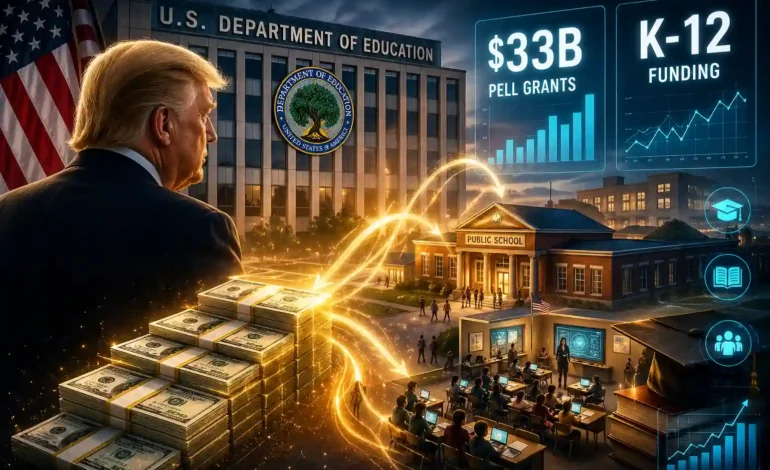
Pell Grants saw an increase in funding during the Trump Administration, with $33 billion allocated annually to help low-income students afford higher education. The emphasis on maintaining and expanding Pell Grant funding aligned with Trump’s desire to make higher education more accessible for working-class Americans.
Teacher Quality Partnership Grants
The Trump Administration’s approach to Teacher Quality Partnership Grants sought to encourage improvements in teacher training, particularly in STEM fields. However, with limited increases in education funding, many of these programs were restructured to maximize efficiency.
Other Significant Federal Education Programs
- Equity Assistance Centers – Aimed at improving equity in schools, these centers faced a reduction in funding but continued to operate with a focus on helping underserved communities.
- English Language Acquisition Grants – A consistent funding stream aimed at helping non-English-speaking students, which saw limited but steady support under the Trump budget.
- Comprehensive Centers Program – These centers, which provide technical assistance to school districts, faced some restructuring as part of Trump’s broader education policy shift.
- Preschool Development Grants – These grants were particularly controversial, as Trump’s administration proposed consolidating them into other funding categories, which led to debates about the importance of early childhood education.
3. K-12 & Federal Funding Streams: A Breakdown of Key Education Budget Cuts and Allocations
The Trump Administration made several adjustments to federal funding streams impacting K-12 education, leading to both criticism and support.
- Title I Funding: A major funding stream aimed at assisting low-income schools faced cuts, as the administration sought to redirect resources away from traditional public schools in favor of other programs like school choice.
- Title II Funding: Funding for teacher development programs was also trimmed, causing concern about how states would continue to ensure quality education.
- Title III Funding: Title III funding, which supports English language learners, was reduced under the Trump Administration, prompting debate over how to balance these cuts with the growing need for multilingual education.
- Title IV Funding: This funding, which covers a wide range of student support services, including mental health, technology, and community partnerships, saw some consolidations.
4. Key Policy Shifts and Strategic Directions
Artificial Intelligence (AI) in Education Grants
AI and technology played a growing role in Trump’s education policy. The administration aimed to support innovations in AI and computer science education, allocating funding for programs that sought to prepare students for future careers in these rapidly evolving fields. The emphasis on AI in education grants opened up new funding avenues for schools and universities to implement cutting-edge technology in their curricula.
School Choice and Education Freedom Tax Credit
Trump’s focus on school choice and expanding access to private and charter schools was clear in his administration’s policies. The Education Freedom Tax Credit was proposed as a way to give parents more control over their children’s education. The policy was seen as a direct challenge to the traditional public school system, promoting alternatives to improve educational outcomes.
Returning Education to the States
A key priority for Trump was the decentralization of education control, with many funding decisions shifting away from the federal government and more authority granted to individual states. This was in line with the broader conservative view of reducing federal involvement in local governance.
5. Government Agencies & Key Figures Shaping Education Policy
Numerous government agencies and key individuals played vital roles in the administration’s approach to education:
- U.S. Department of Labor, U.S. Department of Health and Human Services, and U.S. Department of the Interior – These agencies saw increased collaboration with the Department of Education on vocational education programs and workforce development.
- Linda McMahon and Russell Vought were instrumental in pushing Trump’s budget agenda, often advocating for cuts in education funding while supporting initiatives in workforce development.
6. Financial Implications of Trump’s Education Budget
Trump’s education budget saw significant reallocations, including:
- $8.5 billion in K-12 funding cuts
- $6.5 billion in federal grant program consolidations
- $33 billion for Pell Grants
- $1.2 billion increase for IDEA (Individuals with Disabilities Education Act)
- $208 million for mental health initiatives
- $6.8 billion withheld funding for the year 2026
These shifts have had a lasting impact on school systems, especially in underserved communities, where funding cuts were most keenly felt.
7. Legal Frameworks and Education Acts Under Trump
Several important laws and acts continued to guide federal education policy:
- Clery Act – Protecting students from sexual assault and ensuring transparency in campus safety.
- Workforce Innovation and Opportunity Act – Supporting job training and education programs that align with workforce demands.
- Carl D. Perkins Career and Technical Education Act – Focused on improving technical education and vocational training programs.
- Title IX – Ensuring equal educational opportunities for men and women, particularly in athletics and other areas.
Conclusion: The Future of Education Grants Under Trump’s Legacy
The Trump Administration’s approach to education was characterized by both substantial budget cuts and strategic investments in certain areas, such as AI, STEM education, and school choice. While some changes have been polarizing, the legacy of Trump’s education policies will continue to shape the funding and structure of federal education programs for years to come. Understanding these shifts is essential for policymakers, educators, and students alike to navigate the evolving landscape of U.S. education.
FAQ’s
1. What changes did the Trump Administration make to the Department of Education’s funding?
The Trump Administration introduced cuts to federal education programs, including a proposed $8.5 billion reduction in K-12 funding and the consolidation of several grant programs.
2. Did President Trump propose any increases in education funding?
Yes, Trump proposed increases for specific programs such as the Pell Grants, which received around $33 billion in annual funding to assist low-income students.
3. Who gets funding from the U.S. Department of Education under Trump’s policies?
Federal education grants under Trump’s administration were primarily allocated to K-12 schools, higher education institutions, vocational programs, and students with disabilities.
4. Did Trump discontinue Pell Grants?
No, Pell Grants were not discontinued but were instead maintained and even increased by Trump’s administration, especially for low-income college students.
5. How did Trump’s budget affect students with disabilities?
Under Trump, funding for the Individuals with Disabilities Education Act (IDEA) was increased by $1.2 billion, aiming to improve educational services for students with disabilities.
6. Did the Trump Administration propose to eliminate the U.S. Department of Education?
While there was significant debate about the role of the Department of Education, Trump did not succeed in eliminating it. However, his administration pushed for decentralizing educational control and shifting responsibilities to state governments.
7. What is the future of federal education grants after Trump’s presidency?
Federal education grants may continue to evolve, but Trump’s policies have left a legacy of emphasizing school choice and greater state control over education funding.
8. Will the Department of Education be closed under future administrations?
The closure of the Department of Education is unlikely but has been a point of discussion in certain political circles. Most education policies will continue to evolve based on the priorities of the sitting president.
9. What is the 2026 education grant, and is it real?
The 2026 education grant refers to a proposal under Trump’s administration to withhold $6.8 billion in funding for specific educational purposes, which became a topic of concern and debate.
10. How much is the monthly payment on a $70,000 student loan?
Monthly payments on a $70,000 student loan vary based on the interest rate and repayment term but could range from $500 to $800 per month for a standard 10-year loan.
11. How much would the monthly payment be on a $50,000 student loan?
For a $50,000 student loan, the monthly payment could range from $350 to $600 depending on the loan term and interest rate.
12. What is the best way to pay off student loans?
The best way to pay off student loans is through a combination of strategies, such as enrolling in income-driven repayment plans, refinancing, and focusing on high-interest loans first.
13. Will student loans be forgiven in 2026?
There are no official federal plans to forgive all student loans in 2026, but there may be specific forgiveness programs for qualifying individuals.
14. What happens if I haven’t paid my student loan in 20 years?
If you haven’t paid your student loan in 20 years, it could potentially be eligible for forgiveness under certain income-driven repayment plans, but interest will continue to accumulate.
15. Can I get 100% student loan forgiveness?
Student loan forgiveness programs, such as Public Service Loan Forgiveness (PSLF), allow for 100% forgiveness if certain conditions are met, such as working for qualifying employers and making qualifying payments.
16. Does your student loan get wiped after 20 years?
Under income-driven repayment plans, student loans may be forgiven after 20 years, but this depends on the type of loan and repayment plan.
17. How long does it take to pay off $100,000 in student debt?
The repayment time for $100,000 in student debt depends on your loan term and interest rate. For standard 10-year loans, the payment could be about $1,100 per month, but income-driven repayment plans could extend the term to 20-25 years.
18. What happens to a student loan after 25 years?
After 25 years in an income-driven repayment plan, federal student loans may be forgiven, but you could face tax consequences on the forgiven amount.
19. Is it worth paying off your student loan early?
Paying off student loans early can save on interest payments, but it depends on your financial situation. Refinancing may also be an option to secure lower interest rates.
20. What is the average student loan debt for a 30-year-old?
The average student loan debt for a 30-year-old in the U.S. is approximately $40,000 but can vary based on educational attainment and career path.
21. Which age group has the most student loan debt?
The age group 30 to 39 typically holds the most student loan debt, as many individuals in this group are still paying off their loans or have taken on additional education costs.
22. What are Title I and Title II funding in education?
Title I funding supports low-income schools, while Title II focuses on improving teacher quality and professional development programs.
23. What is the Pell Grant and how is it different from other federal grants?
The Pell Grant is a federal financial aid program designed to help low-income undergraduate students afford college. Unlike loans, Pell Grants do not require repayment.
24. How are federal education grants allocated under Trump’s administration?
Under Trump, federal education grants were redistributed with some cuts, but specific programs like Pell Grants and teacher quality initiatives continued to receive significant funding increases.
25. What is the Education Freedom Tax Credit (EFTC)?
The Education Freedom Tax Credit (EFTC) was a proposed program aimed at expanding school choice by providing tax credits for donations to organizations that fund scholarships for private school tuition.